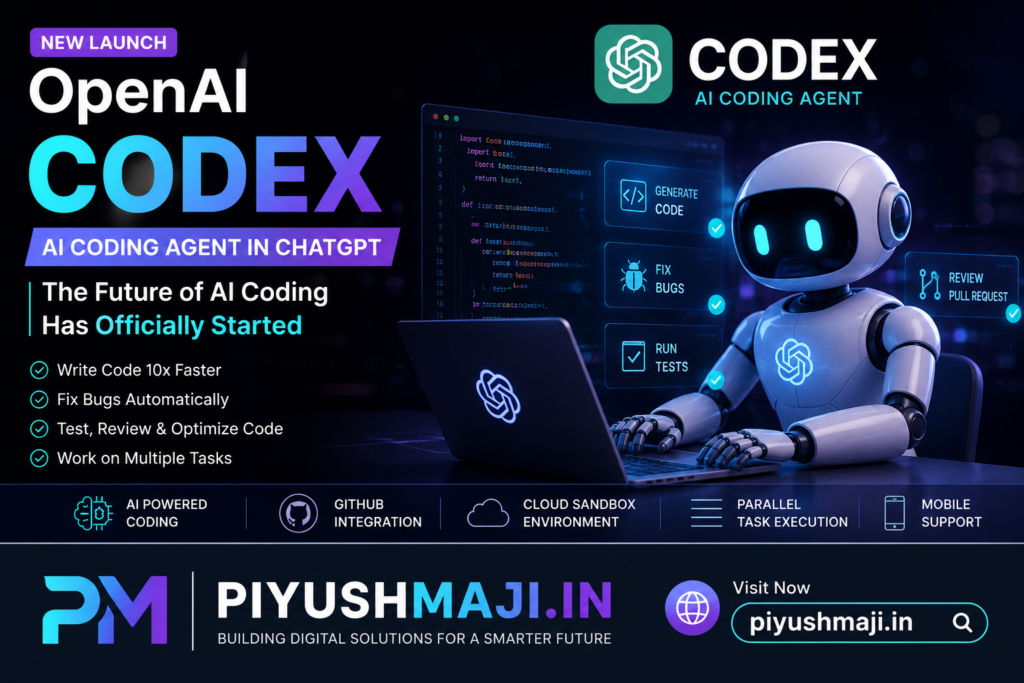

Artificial Intelligence is changing software development faster than ever, and now OpenAI has taken a massive step forward by launching Codex inside ChatGPT. This new AI coding agent is designed to help developers write code, fix bugs, test applications, review repositories, and even work like a virtual software engineer.
If you are a developer, programmer, startup founder, student, or tech enthusiast, this new launch could completely change the way you build software.
In this detailed guide, we will explain:
- What is OpenAI Codex?
- How Codex works in ChatGPT
- Features of Codex AI coding agent
- Codex vs GitHub Copilot vs Claude Code
- Benefits for developers
- Future of AI coding
- SEO keywords and trends around AI programming tools
What Is OpenAI Codex?
OpenAI introduced Codex, an advanced AI coding agent integrated directly into OpenAI ChatGPT. The system is powered by a specialized model called codex-1, optimized specifically for software engineering tasks.
Unlike normal AI chatbots that only generate code snippets, Codex can:
- Understand full codebases
- Fix bugs automatically
- Write production-ready features
- Run tests
- Review pull requests
- Answer coding questions
- Work on multiple tasks simultaneously
This makes Codex one of the most advanced AI coding assistants ever released.
Why OpenAI Codex Is a Big Deal
The launch of Codex signals a huge shift toward AI-powered software engineering.
Previously, developers used AI mainly for:
- code completion
- debugging help
- syntax suggestions
But Codex acts more like:
“An AI teammate for developers.”
According to OpenAI, Codex can independently handle engineering tasks that normally take human developers hours or even days.
Key Features of OpenAI Codex
1. AI Agent for Coding
Codex works as a real AI agent instead of a simple chatbot.
You can assign tasks like:
- “Build a login page”
- “Fix this bug”
- “Optimize this API”
- “Create unit tests”
Then Codex starts working automatically.
2. GitHub Integration
Codex connects with GitHub repositories and understands your existing project structure.
This allows developers to:
- analyze large codebases
- edit existing applications
- review files intelligently
- generate pull requests
3. Parallel Task Execution
One of the most powerful features is that Codex can handle multiple coding tasks at the same time.
This means:
- bug fixing
- feature development
- documentation
- testing
…can happen simultaneously.
4. Cloud-Based Sandbox Environment
Codex runs inside a secure cloud sandbox.
Benefits:
- safer execution
- isolated environment
- reduced security risks
- controlled AI behavior
5. Mobile Support Through ChatGPT
OpenAI recently expanded Codex to mobile devices via the ChatGPT app. (Reuters)
Developers can now:
- monitor coding tasks
- approve changes
- manage AI agents
- review outputs
…directly from Android and iPhone devices.
This is a major step toward mobile AI software development.
How OpenAI Codex Works
Codex uses natural language instructions.
Example:
“Create a responsive React dashboard with authentication and dark mode.”
The AI then:
- Understands the request
- Analyzes project context
- Generates code
- Runs tests
- Suggests improvements
- Returns the final output
This drastically reduces development time.
OpenAI Codex vs GitHub Copilot
| Feature | Codex | GitHub Copilot |
|---|---|---|
| Full AI Agent | Yes | Limited |
| Understands Full Codebase | Yes | Partial |
| Parallel Tasks | Yes | No |
| Autonomous Testing | Yes | Limited |
| GitHub Integration | Yes | Yes |
| Mobile Access | Yes | No |
| Multi-Step Reasoning | Advanced | Basic |
Codex is designed for agentic software engineering, while GitHub Copilot mainly focuses on autocomplete assistance.
OpenAI Codex vs Claude Code
Anthropic’s Claude Code is another major competitor in the AI coding space.
However, Codex offers:
- deeper ChatGPT integration
- stronger ecosystem support
- cloud task management
- mobile workflow support
- parallel execution systems
The competition between OpenAI and Anthropic is rapidly accelerating AI software development innovation.
Best Use Cases for OpenAI Codex
Web Development
- React apps
- Next.js projects
- APIs
- dashboards
- admin panels
Mobile App Development
- Flutter
- React Native
- Android Studio support
Debugging
Codex can analyze and fix errors quickly.
Documentation
Generate technical docs automatically.
Learning Programming
Students can learn coding concepts interactively.
Benefits of OpenAI Codex for Developers
Faster Development
AI can generate features within minutes.
Reduced Repetitive Work
Developers focus more on strategy and creativity.
Improved Productivity
Teams can complete projects faster.
Better Testing
Automated code testing improves software quality.
Beginner Friendly
New programmers can build applications more easily.
Is AI Replacing Programmers?
This is one of the most searched questions right now.
The answer is:
No — but AI is changing programming forever.
Developers who use AI tools like Codex will become significantly more productive than those who do not.
Future developers will spend more time:
- reviewing AI outputs
- designing systems
- managing workflows
- solving business problems
Instead of writing repetitive code manually.
Future of AI Coding
The future of software engineering is becoming increasingly “agentic.”
Research shows that AI coding agents are already contributing to massive numbers of GitHub pull requests across real-world repositories.
Experts predict:
- AI-assisted coding will become mainstream
- Software teams will use multiple AI agents
- Human developers will supervise AI systems
- Development speed will increase dramatically
OpenAI’s Codex is one of the clearest examples of this future.
Who Can Access OpenAI Codex?
Initially, Codex launched for:
- ChatGPT Pro users
- Enterprise users
- Team subscribers
OpenAI plans wider availability in the future.
SEO Keywords You Should Know
Here are trending SEO keywords related to Codex and AI coding:
- OpenAI Codex
- Codex AI
- ChatGPT coding agent
- AI coding assistant
- OpenAI AI programmer
- AI software engineer
- AI code generator
- ChatGPT for coding
- AI web development tools
- best AI coding tools
- AI developer assistant
- GitHub Copilot alternative
- Codex vs Claude Code
- AI programming future
- AI software development
Final Thoughts
OpenAI Codex is not just another coding assistant.
It represents the beginning of a new era where AI becomes an active software engineering partner.
From:
- generating code,
- fixing bugs,
- reviewing repositories,
- running tests,
- managing workflows,
…Codex is moving AI development toward fully autonomous programming systems.
For developers, startups, and tech businesses, learning how to use AI coding tools like Codex may become one of the most valuable skills of the next decade.
As AI continues evolving, software development will likely become faster, smarter, and more collaborative than ever before.